 Nexcubator
Blog · 28 September 2026 · 13 min read
What Is Nexcubator? Integrated Business Software With No Fragmented Processes
A customer signs. Sales records it in the CRM. Someone copies the details into the project tool, someone else into the billing system, and HR finds out about the new hire from an email. Each step is a process. None of them is connected to the next.
That is a fragmented process, and most organisations run dozens of them. Nexcubator is integrated business software built so that they cannot happen: every process is integrated by default, because every part of the product reads and writes the same records.
This post is written for the people who decide what a business runs on: CEOs, CIOs, operations leaders and the implementation teams who have to make it work.
What "integrated by default" means
Integrated by default means there is only one copy of every record, so there is nothing to integrate.
Most "integrated" software is really connected software. Each app keeps its own copy of the customer, the employee or the project, and integrations copy changes from one to another. Connected software works until a sync fails, a field is renamed or one vendor changes its API. Then the copies drift apart, and people fix it by hand.
In Nexcubator, a person, a customer, a job, an hour and an invoice are each written down once. Pay, job costing, the org chart, the timesheet and the bill all read that same entry. Change a consultant's hourly rate from €62 to €68 and the open quotes, this month's invoices and the project margin are right the moment you save. There is no second system to update because there is no second copy.
| Connected software | Integrated by default | |
|---|---|---|
| Where records live | A copy in every app | Once, in one place |
| How changes travel | Integrations sync them, when they work | Nothing to travel: every app reads the same record |
| What breaks | Syncs, mappings and API changes | Nothing between the parts |
| Who keeps it working | IT, or an integration partner | No one needs to |
Seven signs your processes are fragmented
If three or more are true, your processes are fragmented, and the cost is being paid in people's time. We look at what that costs a smaller business in Your Business Runs on Twelve Apps.
Best-of-breed apps, a traditional ERP, or integrated by default?
Organisations usually pick between two options: a set of best-of-breed apps joined by integrations, or a large ERP suite customised to fit. Nexcubator is a third option.
| Best-of-breed apps | Traditional ERP or suite | Nexcubator | |
|---|---|---|---|
| Records | A copy in each app, kept in step by integrations | One database, with modules | One set of records every nex app reads |
| Your data model | Each vendor's own, fixed | Chosen for you, changed by customisation | Your choice, configured in the app |
| Adding an entity or a column | Often not possible | A customisation project | A business user does it in the app |
| Changing hierarchy, roles or access | App by app | Consultants and developers, then re-testing | Typed in plain English, applied on the fly |
| Bringing data in | Each app's import template | Fixed migration templates and scripts | Any format, mapped once with nex-calibrate |
| Implementation | Quick per app, slow in total | Months | Configured, not built: weeks turn into days |
| AI | A separate assistant per app, each seeing a part | Often an add-on | One assistant that sees the whole business and drafts for people to approve |
Best-of-breed gives each team a tool it likes and leaves the gaps between them to people. A traditional ERP closes the gaps but asks the business to fit the software, and every difference becomes a customisation to carry through each upgrade. Integrated by default keeps the one set of records without the fixed shape.
Most business software forces you to choose one data model and fit your organisation into it. Nexcubator lets you choose and configure your own data model, through configuration in the app, not through development cycles. From one organisation to the next, the software adapts; the business does not bend.
The eleven nex apps
Nexcubator is made of eleven apps, each doing one job, all on the same records. In order, from people to customers:
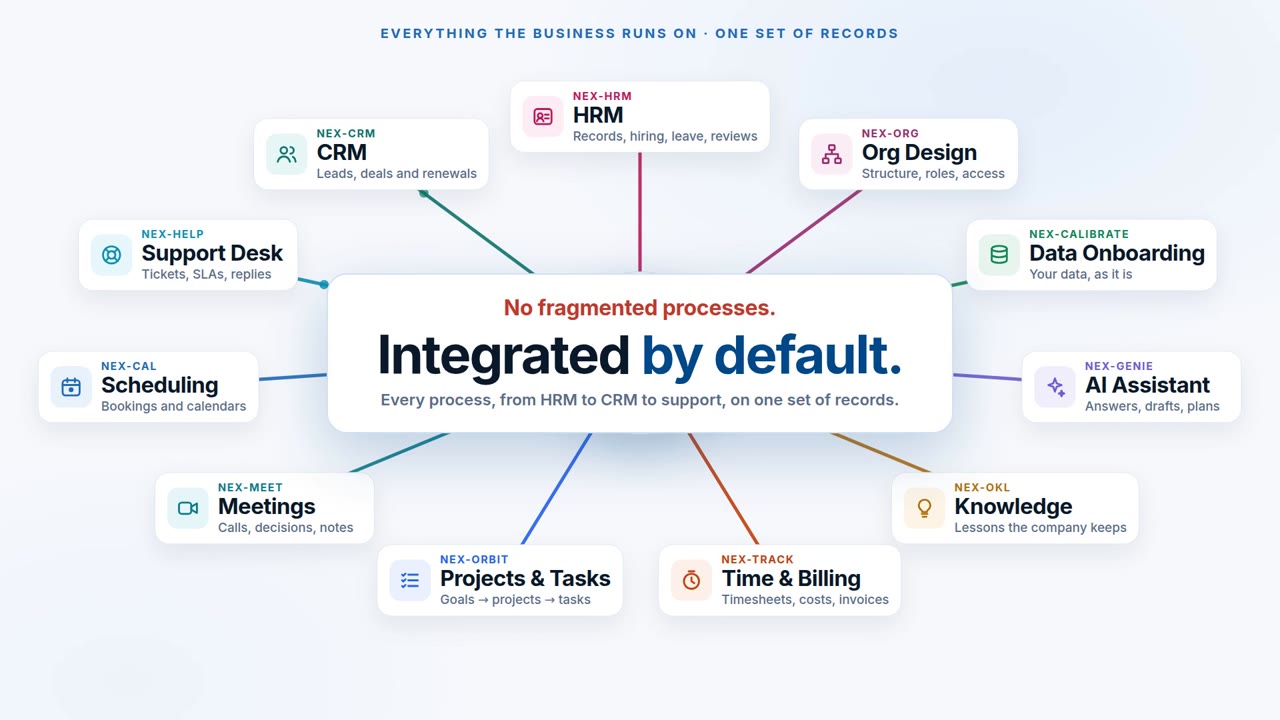
- HRM (nex-hrm). People records, hiring and onboarding, leave, reviews and offboarding.
- Org design (nex-org). Your hierarchy, roles, approvals and who sees what, tested before they go live. See setting up your teams.
- Data onboarding (nex-calibrate). Your existing data brought in as it is, in any format, with no import template.
- AI assistant (nex-genie). It answers, drafts and proposes. A person always decides. See the AI assistant.
- Knowledge and learning (nex-okl). Objectives, knowledge and lessons that stay with the company when people move on.
- Time and billing (nex-track). Timesheets, costs and invoices: hours drafted, approved and billed the same day. See time, costs and billing.
- Projects and tasks (nex-orbit). Project and task management where every task is tied to a goal.
- Meetings (nex-meet). Video meetings where decisions and notes are kept, not lost in an inbox.
- Scheduling (nex-cal). Bookings, calendars and reminders, set up in a sentence.
- Support desk (nex-help). Customer tickets, SLAs and replies, on the same record as the customer.
- CRM (nex-crm). Leads, deals and renewals, on the same records as the work you deliver.
You do not have to switch them all on at once. Start with the part that hurts most; each one hands off to the next as you add it.
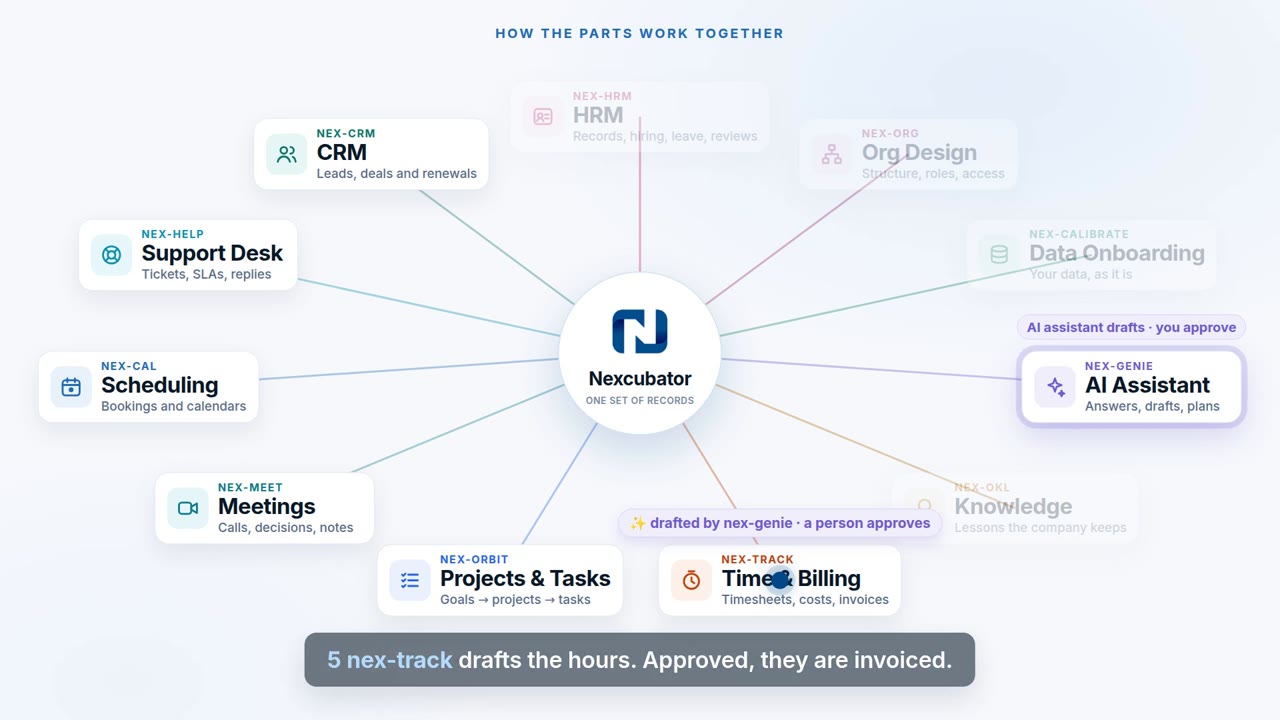
How one piece of work flows through them
Follow a single customer from signature to invoice. Nobody re-types anything.
- A deal is won in nex-crm. From then on, the customer's requests land in nex-help, on the same record.
- A request that needs a call is booked in nex-cal.
- The meeting runs in nex-meet and agrees the work.
- nex-orbit turns it into a project and tasks, each tied to a goal.
- nex-track drafts the hours for that work. Once approved, they are on the job and on the invoice.
- What was learnt is kept in nex-okl, so the next team starts from it.
Underneath, people come from nex-hrm, structure from nex-org and existing data from nex-calibrate. At every step the AI assistant drafts and a person decides. For a week of work followed in detail, see How Nexcubator works.
What nobody else does
Plenty of software calls itself all-in-one. These three things are what make Nexcubator different, and each one is a framework we built rather than a feature we added.
1. Type it in plain English, and it changes on the fly
A business user or admin writes the change in plain English, and Nexcubator applies it straight away. "Add a Cost centre field to People." "Leave is approved by the head of the service." "Make Sarah the safeguarding lead." Each one is live in seconds, recorded, and can be undone in one click. A change that would break the structure, such as a reporting loop, is stopped with the reason in plain words.
2. Configure once, import in any format, adjust on the fly
Import your data once, in whatever format it is in. After that, the structure changes around the data, not the other way round.
- "John and Adam report to Lisa." The hierarchy changes and the existing records follow it. No data re-import.
- "Area managers can see pay for their own region." The access model changes straight away. No re-deployment and no database scripts.
- "Add a Region field to People." A new column appears on every person. No developer.
3. Every screen flips into a sentence
Any list can be read as a plain-English brief and changed by saying what you want to see. No report request, no export and no dashboard to build. The full story is in Tired of Clicking, Filtering and Sorting? Flip It.
What it changes for implementation teams and CIOs
- From organisation to organisation, the software adapts. Every business is shaped differently, and Nexcubator is configured to each one. It is never forced to fit the software.
- Consultants configure. They don't build. Setup is configuration, not a development project.
- Implementation hassle gone, roll-out smooth. Weeks of implementation turn into days.
- Frequent UAT rounds, backed by automated regression tests every time data changes. Changes are checked against real situations before they are real.
- Developers only for what is truly new. Everything else belongs to your implementation team on day one and your own administrators after that.
- One audit history. Every change, by a person or by the assistant, is recorded against the thing it changed. More in Keeping your information safe.
The follow-up post Configure, Don't Customise shows how nex-calibrate, nex-org and nex-genie do this in practice.
Questions to ask any all-in-one business software vendor
Whatever you choose, these questions separate integrated software from connected software with a single logo on top:
- Is each record stored once, or synced between modules?
- Can a business user add an entity or a column without a developer?
- Can we change our hierarchy, roles and access without re-importing data or redeploying?
- Can we import data in the format we already have, or only in your template?
- How is every change tested before go-live, and is regression testing automated?
- Does the AI act on its own, or does a person approve every change?
- What will need a developer, and what will not?
The ideas behind Nexcubator
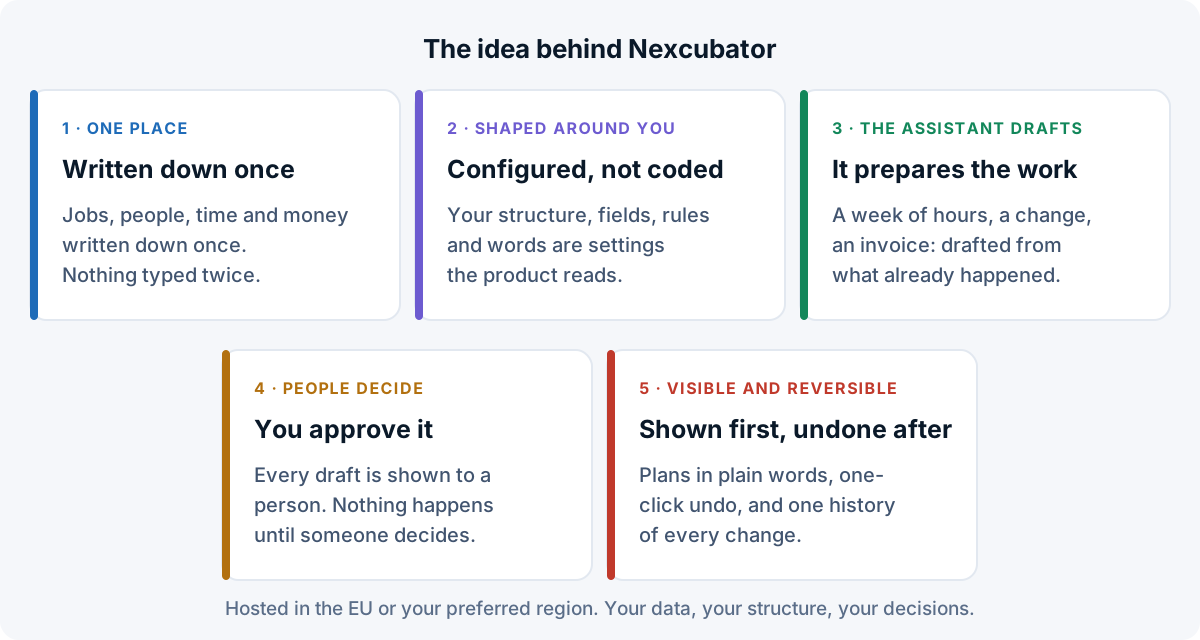
Five ideas shape every nex app. Each has its own deep dive:
- Written down once. One set of records for the whole business: see How Nexcubator works.
- Configured, not coded. An approach we call Software as a Capability; the Configure, Don't Customise post covers it.
- The assistant drafts. It prepares the week, the change or the invoice: see the AI assistant.
- People decide. Nothing counts until a person approves it, and every change can be undone.
- It learns in words you can read. Corrections become rules you can read and delete, and what a team learns is kept: see Your Company Keeps Learning the Same Lesson.
Where each part stands
| App | What it is for | Today |
|---|---|---|
| nex-hrm | People and HR | Being built |
| nex-org | Designing and testing your structure | Being built |
| nex-calibrate | Bringing your data in as it is | Being built |
| nex-genie | AI assistant: answers, drafts and plans you approve | In early access, growing |
| nex-okl | Objectives, knowledge and learning | In early access |
| nex-track | Time, costs and billing | Being built |
| nex-orbit | Projects and tasks, tied to goals | Being built |
| nex-meet | Meetings with notes kept in Nexcubator | In early access |
| nex-cal | Scheduling and bookings | In early access |
| nex-help | Support desk: tickets, SLAs and replies | Being built |
| nex-crm | Customers, leads and renewals | Being built |
We would rather tell you what is not finished than show you a screen that does not exist yet. See all modules and pricing for the current picture.
Frequently asked questions
What is Nexcubator?
Nexcubator is integrated business software. Eleven nex apps, from HRM (nex-hrm) and org design (nex-org) to projects and tasks (nex-orbit), time and billing (nex-track), a support desk (nex-help) and CRM (nex-crm), run on one set of records, so every process is integrated by default. Its AI assistant (nex-genie) drafts work for people to approve.
What is integrated business software?
Integrated business software runs several business functions, such as HR, projects, billing and CRM, on one shared set of records. Because each record exists once, work passes from one function to the next without exports, re-typing or integrations to maintain.
What is the difference between integrated and connected software?
Connected software keeps a separate copy of each record in every app and uses integrations to keep the copies in step. Integrated software keeps one copy that every part reads, so there is nothing to sync and nothing to drift apart.
Is all-in-one software better than best-of-breed apps?
Best-of-breed apps suit teams that want the deepest tool for one job and can maintain the integrations between them. All-in-one software suits organisations whose real cost is the handover between teams. Nexcubator adds a third point: it is all-in-one without forcing one fixed data model on you.
Is Nexcubator an ERP?
It covers much of the same ground as an ERP, from HRM to projects, time, billing and CRM, but it is configured rather than customised. Your structure, fields and rules are settings your own team can change, so it fits how you work instead of asking you to fit it.
What is the difference between configuration and customisation?
Customisation changes the software's code to fit your organisation, and has to be carried through every upgrade. Configuration changes settings the software already reads. In Nexcubator your data model, hierarchy, roles and access are configuration, changed in the app or in plain English.
Does the Nexcubator AI assistant make changes by itself?
No. It drafts and proposes. Every change is shown as a plan in plain words, nothing happens until a person approves it, and every change can be undone.
Where is my data kept?
In the EU by default, or in the region you prefer: hosting is configured to suit your organisation's data residency requirements. You decide who can see what, including who can see pay, and every change is recorded in one audit history.
Related reading
- How Nexcubator works: one week of work followed from the hours logged to the money in the bank.
- Your Business Runs on Twelve Apps: what fragmented tools cost a smaller business.
- Tired of Clicking, Filtering and Sorting? Flip It: every screen as a sentence.
- Your Company Keeps Learning the Same Lesson: how nex-okl keeps what a company learns.
- Keeping your information safe: one set of records, one set of rules.
Where it stands
Nexcubator is in early access and free to try while it is. Some nex apps run today and others are being built, as the table above shows. Next in this series, we introduce the nex apps one by one, starting with nex-calibrate, nex-org and nex-genie.
If your processes are fragmented across a dozen apps and the people in between, that is exactly the conversation we want to have.
Nexcubator is business software by Aitina Tech. Request early access and tell us how you run your business today.
Nexcubator is built on two Aitina Tech frameworks: Software as a Capability and OKL. The engineering practice behind posts like this one is AI harness engineering.
This is the product it came out of.
Nexcubator runs jobs, people, time and money in one place, hosted in the EU or in your preferred region. Free during early access.
Request early access More posts