 Nexcubator
Blog · 18 September 2026 · 5 min read
Your Business Runs on Twelve Apps. Here Is What That Costs.
Nobody decided to run the business on twelve applications. It just happened, one sensible purchase at a time.
Count them
Do this before you read on. Count the systems your company pays for that hold a fact about a person, a customer, a job or an hour.
Payroll. The accounts package. Whatever the jobs live in. A CRM, or the spreadsheet that is pretending to be one. The booking tool. The timesheet app. The shared drive where the contracts are. The thing HR uses. The meeting tool. The support inbox. The project board somebody set up in 2023 and half the team still uses.
Most companies we talk to land somewhere between ten and fourteen. Every one of them was a reasonable decision on the day. Nobody chose the pile. The pile is what reasonable decisions add up to.
The bill you can see
Start with the obvious cost, because it is bigger than people think.
Almost every one of those tools is priced per seat. So every time a new person starts, twelve subscriptions go up. And every time somebody only needs one of them occasionally (the bookkeeper who logs four hours a month, the lad on the vans who never sits at a desk) you face a small, stupid choice: pay a full licence for a person who barely uses it, or leave them out.
Everybody leaves them out. Which is how the system that was supposed to hold the whole business ends up holding about two thirds of it.
The bill you cannot see
That is the cheap part. The expensive part is what happens to the facts.
Here is the simplest way to see it. Somebody’s hourly rate goes up from €62 to €68. That number is written down in the payroll system, in the job costing, in the quote you are halfway through writing, and in next year’s budget. Four places. Whoever gets the pay rise through has to remember all four, and change all four, and change them the same way.
They will miss one. Not through carelessness, because there is no list of the places, and nobody has ever written one. So for the next quarter one of your reports is quietly using €62, and the numbers stop agreeing, and the argument in the Monday meeting is about which spreadsheet is right rather than about the business.
Multiply that by every fact that lives in more than one place. Every customer address. Every job status. Every hour worked. SaaS sprawl is not really a licensing problem. It is a truth problem. Twelve systems means twelve versions of what is true, and a person whose job is silently reconciling them.
The bill nobody puts in a budget
Two more, and then the alternative.
Security. Every link between two of your apps is a password stored somewhere, a key that never expires, a person who left in March but still has a login to the fourth tool because nobody remembered it was there. Twelve suppliers is twelve ways in. Your auditor knows this even if the rest of the company does not.
Onboarding. A new hire gets twelve accounts, twelve invitations, twelve places to learn. A leaver needs twelve places switched off, on the day, by somebody who remembers all twelve. One of them does not get done. It is always one of them.
The alternative is not a bigger app
The usual answer to twelve apps is a thirteenth: an integration layer, a dashboard that reads from all of them, a consultant to wire it up. It does not fix the problem. It adds a place for the facts to disagree and a monthly fee for the privilege. And it is worth being blunt about the other usual answer, just put everything in one database, because anybody can say it and it is not what makes the difference. One record is a storage decision. What matters is that the parts stay in sync without anybody integrating them, and that takes a different way of building software.
The real fix is a different way of buying software altogether, and it is worth understanding even if you never buy from us.
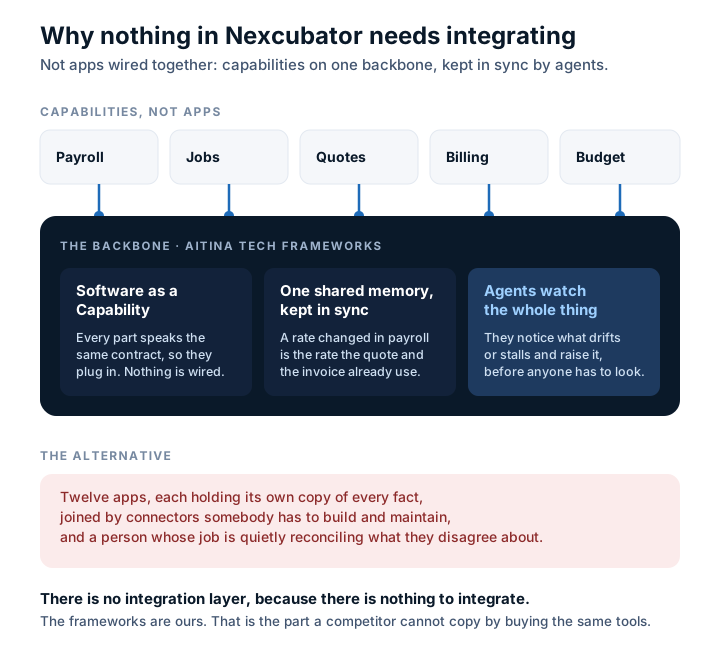
Aitina Tech calls it Software as a Capability, or SaaC, and it is the framework Nexcubator is built on. The idea is simple once you see it. You do not buy an application and count seats. You hire a capability (a slice of competence the business needs, such as keep the job costs right or let customers book time) and you pay for what it does. Every action the capability takes leaves a receipt: what was done, for whom, when, and what it cost. The way a payslip settles a week of work, the receipt settles what the software did.
For the person running the business, this changes three things:
- You switch a capability on, and that is what appears on the bill. Not a seat count. Fifty people or five, the capability costs what the capability costs, so you put everybody in it and the system finally holds the whole business.
- Nothing needs integrating, ever. The capabilities are built on the same framework, so they plug into one backbone and share one memory: the €68 changed in payroll is the €68 the quote and the invoice already use. There are no connectors to build, none to maintain, and no person reconciling. And agents watch the whole thing: when something drifts or stalls, it is raised before anyone has to go looking.
- You can prove what happened. Every receipt is kept. When the auditor, the client or the Revenue asks how a number came to be, the answer is a record, not a reconstruction.
What this looks like in practice
Nexcubator is what we built on this idea: jobs, people, time and money in one place, priced per capability you switch on, built in Ireland and hosted in the EU. Underneath it are two frameworks of our own, Aitina Tech's Software as a Capability and OKL, and an agent layer that keeps the platform honest. That backbone is the part that cannot be copied by buying the same tools we did. The how it works page follows one week of work from the hours logged to the money in the bank, which is a better argument than anything I can write here.
But the point of this post is the idea, not the product. Count your apps. Find the fact that lives in the most places. Ask who reconciles it, and how many hours a month that takes. That number is what sprawl costs you, and it has been costing you that every month since the third app.
Nexcubator is built on two Aitina Tech frameworks: Software as a Capability and OKL. The engineering practice behind posts like this one is AI harness engineering.
This is the product it came out of.
Nexcubator runs jobs, people, time and money in one place, built and hosted in the EU. Free during early access.
Request early access More posts