 Nexcubator
Blog · 19 September 2026 · 7 min read
Your Company Keeps Learning the Same Lesson. Here Is How to Stop.
Every company has learnt the same expensive lesson twice. Most have learnt it four times. This is why, and what we do about it.
The lesson that keeps getting learnt
Here is a story you will recognise, because a version of it has happened where you work.
A job goes badly over. Somebody sits down afterwards and works out why: the supplier quote was accepted before the site survey, and the survey found the thing the quote had not priced. The person who works this out is good. They tell their manager. It comes up at the review. Everybody nods.
Fourteen months later a different team accepts a supplier quote before the site survey. The person who learnt the lesson has moved on, or moved teams, or is on holiday, or is simply not in the room. The lesson was real, it was expensive, and it lived in exactly one head.
Most companies do not have a knowledge problem. They have a keeping problem. The learning happens. It just does not survive contact with the org chart.
And it matters more now than it did five years ago, for a reason worth stating plainly. Everyone has the AI tools. Your competitor has the same models, the same assistants, the same automation you do, at the same price. When the tools are a commodity, the only thing left that a competitor cannot buy is what your company has learnt and kept, the decisions, the patterns, the expensive lessons, accumulated over years. That is the edge. It is also the thing most companies are letting evaporate every time somebody leaves.
Why the usual goal-setting does not fix this
Most companies of any size set goals in some structured way. The common version is OKRs, objectives and key results: you name the objective, pick the numbers that will show progress, and review them each quarter. If you do this, you already have half of what is needed, and it is worth being clear about which half.
OKRs answer one question well: are we on track? You set the objective, you pick the measures, and every quarter you can see whether the number moved. That is useful and we are not arguing against it.
But an OKR has no place to write down what you found out on the way. The objective was met, or it was missed, and the reason (the actual, specific, expensive reason) goes in a slide that is read once. OKRs measure progress. They do not measure learning, and a company that only measures progress will keep re-learning the same things at the same price.
Here is the deeper problem. An objective is a snapshot. You set it, you measure it, the quarter ends, and you start again from zero. Learning is a timeline. It only ever builds on what came before: I learnt this, which means I now know enough to learn that. Think of a snowball rolling downhill, small at first, but every turn picks up what the last one left. A company that keeps its learning compounds. A company that resets every quarter is rolling the snowball back to the top of the hill twelve weeks at a time. We call the difference the Compound Learning Effect, and it is the reason a fifty-person company that learns systematically can out-think a five-hundred-person company that does not.
The fix has three parts, and one is usually missing
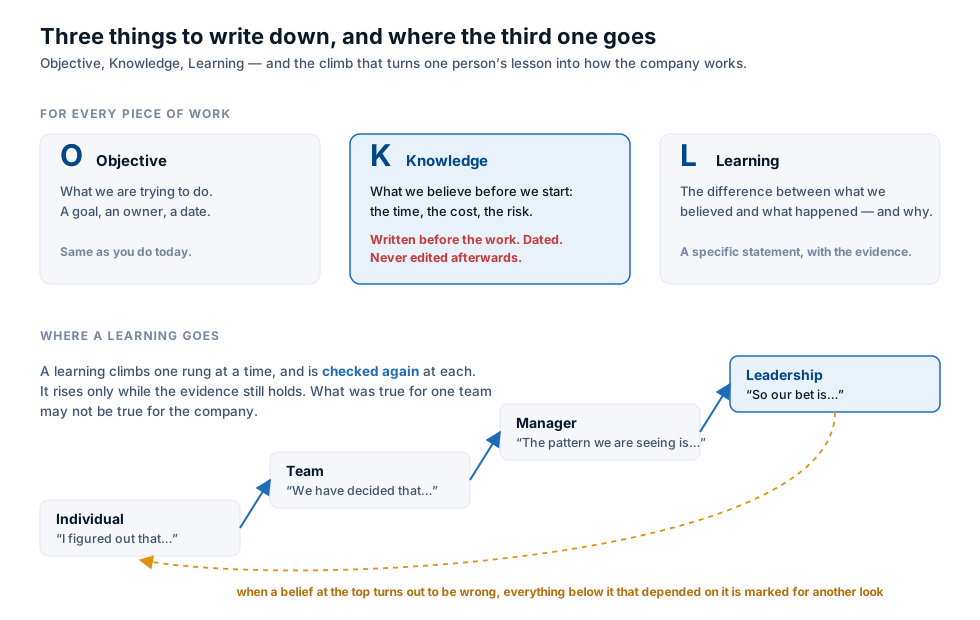
The framework we use is Aitina Tech’s OKL framework. It keeps the objective and adds the two things goal-setting leaves out. The letters stand for Objective, Knowledge, Learning, and in plain English it goes like this:
Objective. What we are trying to do. Same as before: a goal, with an owner and a date.
Knowledge. What we know, or believe, at this point, written down and dated. Before a job begins that means the guess: how long it will take, what it will cost, what we think will go wrong. This is the part people skip, and it is the part that makes everything else work, because of one rule: it is never edited afterwards. The guess is allowed to be wrong. It is not allowed to be quietly corrected once the answer is known. Knowledge is what the company believed on the day, kept honest.
Learning. The difference between what we believed and what happened, and why, and what that now lets us learn next. Not a feeling. A specific statement: supplier quotes accepted before the survey ran over by an average of 18 per cent across the last six jobs, with the evidence attached, and a line to the belief it changes.
That is the whole idea. Write down the guess. Do the work. Write down the difference. It sounds almost too simple to be a framework, and it would be, except for what happens next.
The part that makes it a system: learnings climb
A learning written by one person on one job is worth something to that person. The company gets the value only if the learning climbs.
In OKL a learning starts where it was found (with an individual) and is promoted upwards: to the team, then to the manager’s level, then to leadership. At each step it is checked again, because a thing that was true on one team’s jobs may not be true across the company. A learning only climbs when the evidence holds up at the next level. The site-survey lesson does not stay in one head; it becomes a team rule, then a company rule, and the fourteen-months-later team simply cannot accept the quote first, because the system asks for the survey.
And it works downwards too. When leadership learns that a belief was wrong, everything below that depended on it is marked as needing another look. The stale version does not keep echoing through the lower levels because nobody told them.
For the person running the business, this is the difference between a company that has experienced a lot and a company that knows a lot. Experience lives in people and leaves with them. Knowledge, held this way, is the company’s own.
What it does to the everyday
Three things change quickly, in our experience.
Estimates get honest. When the guess is written down and cannot be edited, people stop guessing to please and start guessing to be right. The gap between guess and actual becomes the most useful number in the building, and it shrinks.
New people get faster. A new hire inherits the company’s learnings, not just its procedures. They can see why the rule exists, with the jobs that taught it. That is a different kind of onboarding from a folder of PDFs.
Reviews change subject. The quarterly meeting stops being about which spreadsheet is right and starts being about which beliefs turned out to be wrong, and what that means for the next quarter. That is the meeting you actually wanted to be having.
A line we will not cross
One thing worth saying plainly, because leaders ask it and they are right to.
OKL is about the work, the jobs, the estimates, the decisions. It is not about people. In Nexcubator, where OKL is built in, the learnings are open at the team level because they are about how the work went. The AI assistant that helps an individual improve is a separate thing, private to that person, switched on only if they choose, and nothing it learns about a person is ever used in a decision about that person. Not by a manager, not by us. We built that as a rule in the software, not a line in a policy, because a learning system that people are afraid of is a learning system nobody writes the truth into.
Where to start
You do not need software to begin, and you do not need anybody's approval. Three things, starting Monday:
- Write the guess first. Pick one kind of work your company does repeatedly. Before the next one starts, write down what you think will happen (time, cost, the risk you are most worried about) and date it. When it finishes, write down the difference and one sentence on why.
- Hold a learning review, not just a progress review. Once a month, the question is not are we on track? but what did we believe that turned out to be wrong, and what do we believe now? Ten minutes. Write the answers down where the next person will find them.
- Chain it. Every time a learning is written down, add one line: this means we can now find out… That line is what turns a lesson into the start of the next one. It is the compound in compound learning.
Do that five times and read the five together.
You will learn something. The question OKL asks is what you will do to make sure the company learns it too, and keeps it after you have moved on to the next thing. Nexcubator’s projects and work is one answer to that question. The habit is the important part.
This post is the written version of an idea first set out in The Software Lens, Episode 2: Everyone Has AI Tools, So What's the Edge?, which introduces the Compound Learning Effect and OKL as the evolution of OKR for a company that intends to keep what it learns.
Nexcubator is built on two Aitina Tech frameworks: Software as a Capability and OKL. The engineering practice behind posts like this one is AI harness engineering.
This is the product it came out of.
Nexcubator runs jobs, people, time and money in one place, built and hosted in the EU. Free during early access.
Request early access More posts