 Nexcubator
Blog · 7 October 2026 · 9 min read
The Intelligent Help Desk: Wake Up to Answers, Not Tickets
Every growing company reaches the same support dilemma. Hire a whole support team to answer tickets, or pull your best engineers and specialists off real work every time a customer is stuck.
Neither scales. A support team without deep product knowledge escalates the hard tickets anyway. Experts on a support rota lose the focused hours your roadmap depends on. And the backlog is waiting every morning either way.
nex-help is built for a third option: anyone on your team can resolve any ticket, because AI agents have already done the groundwork. This post explains what that means in business terms, for the CIOs, CTOs and operations leaders who decide how support runs.
Why most help desks still start from zero
Most help desks are excellent at one thing: putting a ticket in a queue. Then somebody opens it, reads it, works out who the customer is, guesses which part of the product is involved, searches for the last time this happened, and only then starts on an answer.
Many teams have added an AI tool on top. It writes a summary or suggests a reply, but it sees the ticket and little else, so it guesses. It does not know that this customer runs on a custom configuration, that the same error appeared last month on a different account, or that the fix lives in a specific module.
The cost of that guessing lands on your most expensive people. The question for a technology leader is not "should we add AI to support?" It is "where should the AI look, and who stays accountable for the answer?"
Wake up to answers, not tickets
nex-help has a desk agent that works while your team is offline. When people start the day, the inbox is sorted by what needs them, and each new ticket has already been through its workflow: triaged, researched and drafted.
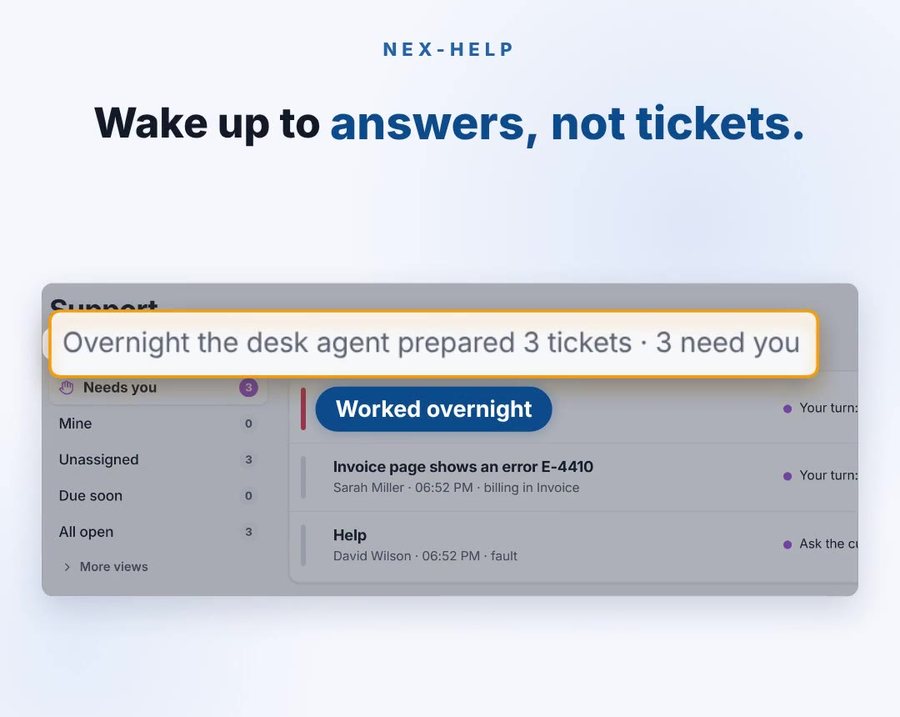
The result is a different first hour. Instead of reading tickets cold, people review prepared work and decide. Routine tickets take minutes. Difficult ones arrive with the investigation already started.
A workflow for every customer, project and industry
Support is not one process. A billing question, a data export failure and a security concern need different people and different checks, and an enterprise customer on a custom setup needs different handling from everyone else.
In nex-help each of those is its own agentic workflow: a drag-and-drop flowchart of steps that starts automatically for the right tickets.
- Per customer or project. A key account can have its own steps, escalation and people.
- Per product module. A ticket about invoicing follows the invoicing workflow; one about sign-in follows another.
- Per industry. Ready-made templates for software, e-commerce, IT, healthcare and property, or start from blank.
- Safe to change. A workflow stays a draft until you publish it, can be tested on a real ticket before it goes live, and every version is kept.
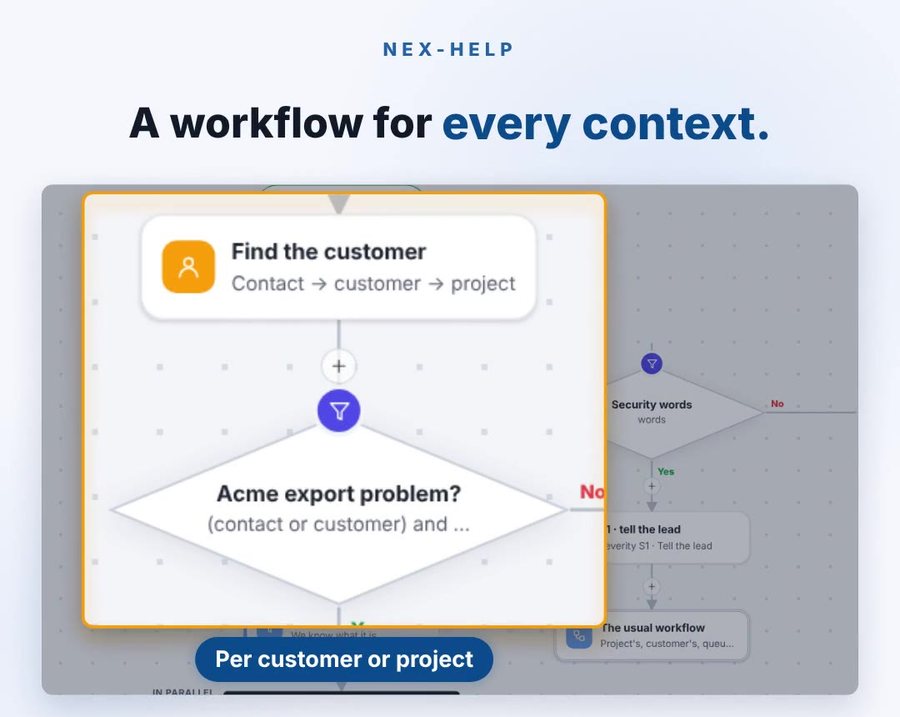
This is the shift from "a help desk with AI" to an intelligent help desk: the process knows where to look, so the AI does not have to guess.
Build it yourself, no waiting on IT
Click the plus sign on any step and add a condition, a person, or your own agent, described in plain words. Your support lead can change how tickets are handled without a development project or a change request.
Agents that work side by side, within a budget
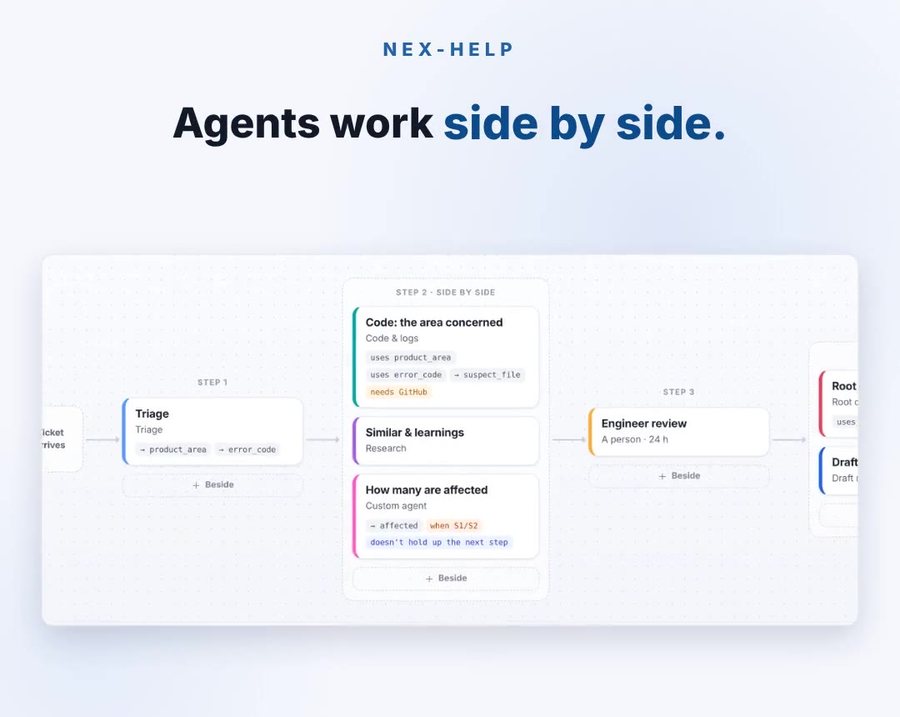
On a hard ticket, nex-help does not ask one AI one question at a time. Several agents work in parallel, each with its own goal: one triages, one looks at the code area and logs concerned, one searches similar past tickets and learnings, one checks how many customers are affected, and one drafts the reply.
Cost-effective AI: no token bonfire
Sending everything to a large model on every ticket is the fastest way to an unpredictable AI bill. In nex-help each step receives only the context it needs. Agents do not scan your entire document repository and source code; they look where the workflow points them, within a budget you set. For a CIO, that means AI cost that scales with tickets resolved, not with the size of your knowledge base.
Not a hunch: a brief with evidence
Every prepared ticket comes with a brief: who is asking, what they are asking about, and what was found, with the evidence cited. A person can see at a glance that the brief is grounded, and open the evidence when they want to check.
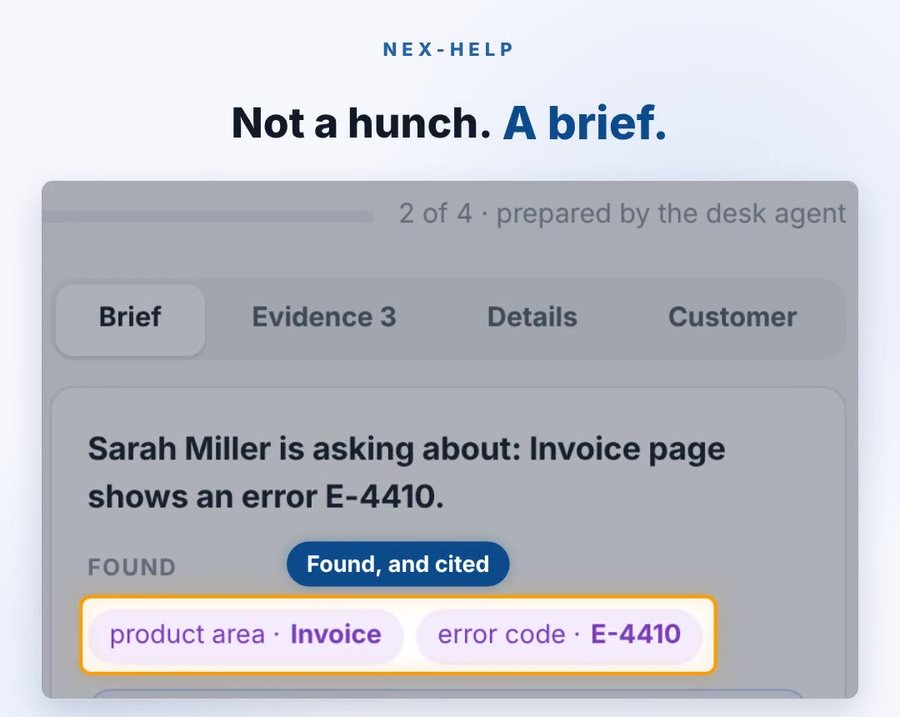
That matters for trust. Teams adopt AI help when they can see its working, and abandon it when they cannot.
Teach it once. It remembers.
When a person knows something the agent did not, they can tell it in plain words, for example "this is the same as the other export report: the nightly job hits the gateway limit". The agent uses that the next time it runs, cites it as theirs, and can run the step again from there or the whole workflow.
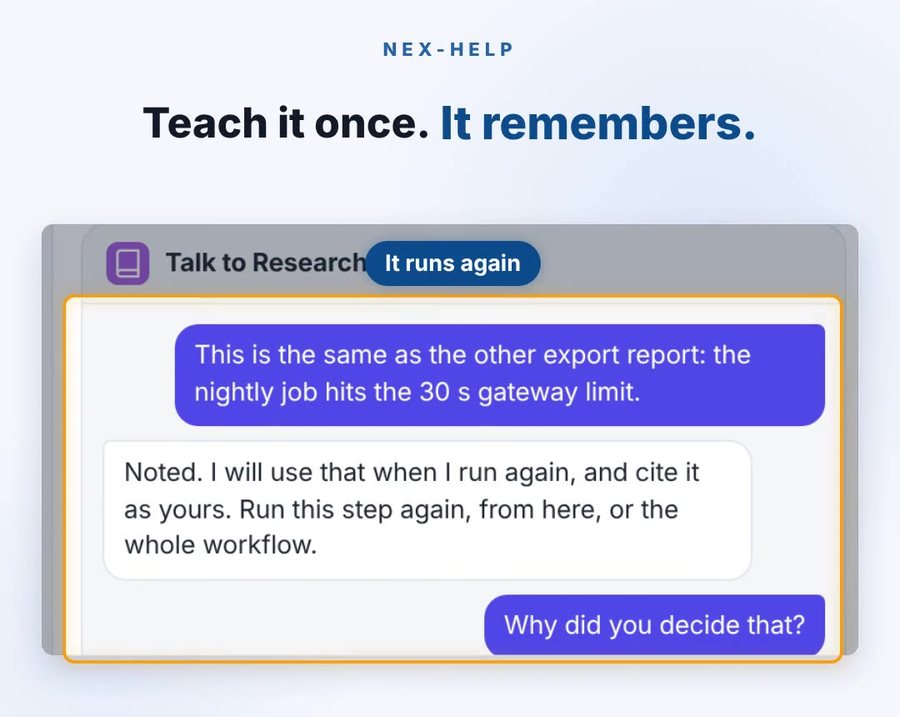
Over time, what your best people know stops living only in their heads. It becomes shared learning that every future ticket benefits from.
AI drafts. People decide.
nex-help never sends a reply on its own. The agent drafts, a named person reviews, edits and approves, and the reply shows that it was AI-drafted and who approved it. Every step and decision is recorded in one history.
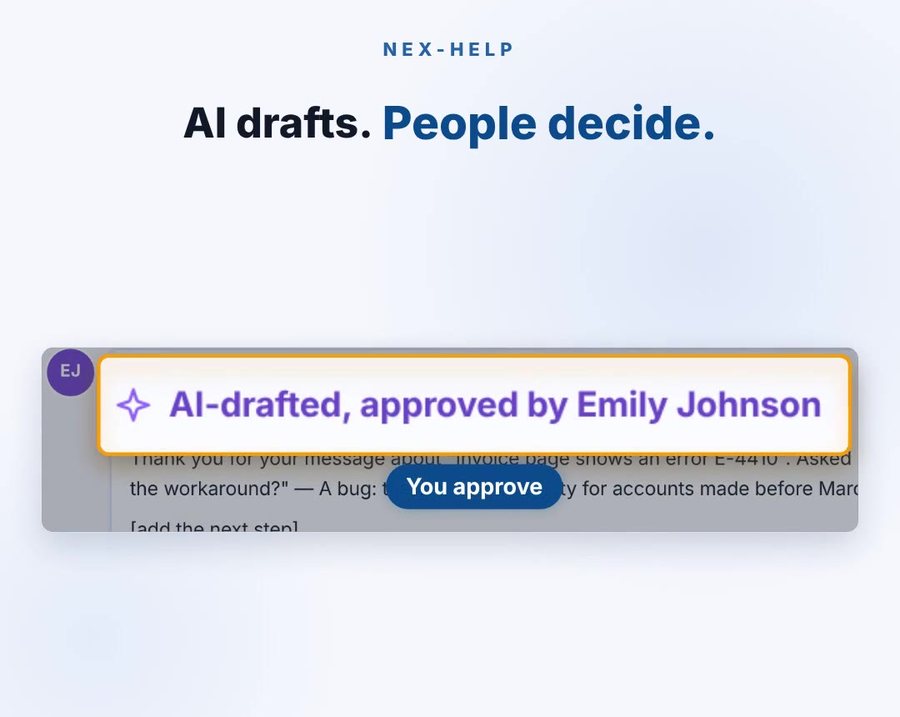
This human-in-the-loop design is not a limitation. It is what lets a regulated or customer-facing business use AI in support at all.
Built for EU data protection and responsible AI
For European organisations, where data goes and who decides matters as much as speed. nex-help is designed with that in mind:
- Hosted in the EU by default, or in the region you prefer for your data residency requirements.
- Names masked before AI reads a ticket. People's names, email addresses and phone numbers are replaced before any model sees the text, and put back by code afterwards.
- A person decides. The AI proposes; people approve. It does not judge or rate people, it works on tickets.
- Your information is not used to train anything, and every change is in one audit history.
For leaders preparing for the EU AI Act and working under GDPR, that combination (minimised data, human oversight and a full record) is the foundation of a compliant AI help desk.
What it means for CIOs and CTOs
- No new support department just to answer tickets. Generalists resolve more, because the investigation is done.
- Experts stay on real work. They are pulled in only when a workflow needs their judgement, and what they teach is kept.
- Predictable AI cost. Context per step and a budget you set, rather than everything sent to a model every time.
- Control without a project. Support leads change workflows themselves, tested and versioned.
- One set of records. In Nexcubator, tickets sit beside the customer, the projects and the work, so a ticket that needs work becomes a task, not a copy in another tool.
Frequently asked questions
What is nex-help?
nex-help is the AI help desk in Nexcubator. AI agents triage, research and draft each ticket following a workflow you design for each customer, project, product module or industry, and a person approves before anything reaches a customer. Tickets sit on the same records as the customer and the work.
How is an AI help desk different from help desk automation?
Traditional help desk automation follows fixed rules: route this, tag that, send a template. An AI help desk does the investigative work as well (finding the customer, the affected area, similar tickets and evidence) and drafts a reply. In nex-help, rules and AI agents live in the same workflow, so you choose where each is used.
Does the AI reply to customers on its own?
No. Agents prepare and draft; a named person reviews, edits and approves every reply. The reply records that it was AI-drafted and who approved it.
Can we use our own process, or are we tied to templates?
Both. Start from a ready-made template for software, e-commerce, IT, healthcare or property, or from blank. Every workflow is a drag-and-drop flowchart you can change, test on a real ticket and publish when ready, with every version kept.
How does nex-help keep AI costs under control?
Each step gets only the context it needs, agents look where the workflow points them rather than scanning everything, and you set a budget. That keeps cost tied to the tickets resolved rather than the size of your documents and code.
Is nex-help suitable for GDPR and the EU AI Act?
nex-help is designed for European data protection: hosted in the EU by default, people's details masked before AI reads a ticket, a person approving every decision, and a full audit history. Your own compliance assessment still applies, and we are glad to walk through it with your data protection lead.
Is nex-help available now?
nex-help is in early beta with selected organisations. Ask for early beta access and see it on your own tickets.
Related reading
- Help desk and ticketing software: how nex-help fits with the customer, the work and the rest of Nexcubator.
- What Is Nexcubator?: integrated business software with no fragmented processes.
- The AI assistant: how nex-genie drafts and people decide.
- Keeping your information safe: hosting, access and audit.
nex-help is part of Nexcubator, business software by Aitina Tech. Ask for early beta access and see nex-help on your own tickets.
Nexcubator is built on two Aitina Tech frameworks: Software as a Capability and OKL. The engineering practice behind posts like this one is AI harness engineering.
This is the product it came out of.
Nexcubator runs jobs, people, time and money in one place, hosted in the EU or in your preferred region. Free during early access.
Request early access More posts